7 Best Shopify Partner Types for Scaling Ecommerce Stores

Your Shopify store is live, products are loaded, and traffic is coming in. But conversion rates are flat, pages load slowly on mobile, and the checkout flow feels like it was built for a different business. The platform is not the problem. The problem is not having the right specialist working on the right part of your store.
Poor website speed, a complicated checkout process, and lack of mobile optimization are among the most common issues that quietly drain revenue from Shopify stores. Most ecommerce managers know something is broken. The harder question is: which type of expert do you actually need to fix it?
The Shopify partner ecosystem includes several distinct specialist types, and hiring the wrong one wastes budget and delays growth. This guide breaks down all seven so you can match your specific bottleneck to the right hire.
What Is a Shopify Partner and Why Does It Matter for Growth?
A Shopify Partner is an agency, freelancer, or developer who has enrolled in Shopify's Partner Program and agreed to its terms. Partners gain access to Shopify's development tools, resources, and in some cases, referral revenue. Choosing an enrolled partner with a track record on Shopify, rather than a generalist web developer, means working with someone who understands the ecosystem at a structural level.
What qualifies someone as a Shopify Partner?
A Shopify Partner is any individual or business that has registered through Shopify's official Partner Program. This gives them access to development stores, Shopify's API suite, and partner-specific support. Partners are bound by the Partner Program Agreement, which gives store owners a code of conduct to hold them to. In January 2026, Shopify announced updates to its Partner Program Agreement and API License and Terms of Use, effective February 27, 2026, covering clearer role definitions, stronger data protection terms, and support for new platform features such as agentic commerce. Working with a partner who stays current with these updates signals they are actively invested in the platform.
How the Shopify Partner ecosystem is structured
Merchants find partners through the Shopify Partner Directory, a curated list of partners and the services they offer. The Directory replaced the older Shopify Experts Marketplace in October 2023. It groups partners into four tiers based on the size of business they typically serve: Select (small and medium businesses), Plus (mid-market and larger), Premier (large enterprises), and Platinum (global enterprises).
For most growing stores, a Select or Plus partner with a strong portfolio is sufficient. For stores doing significant revenue with complex requirements, a Premier or Platinum partner brings deeper experience with enterprise-scale builds. Understanding this structure helps you set the right expectations before you ever get on a discovery call.
The 7 Shopify Partner Types and What Each One Solves
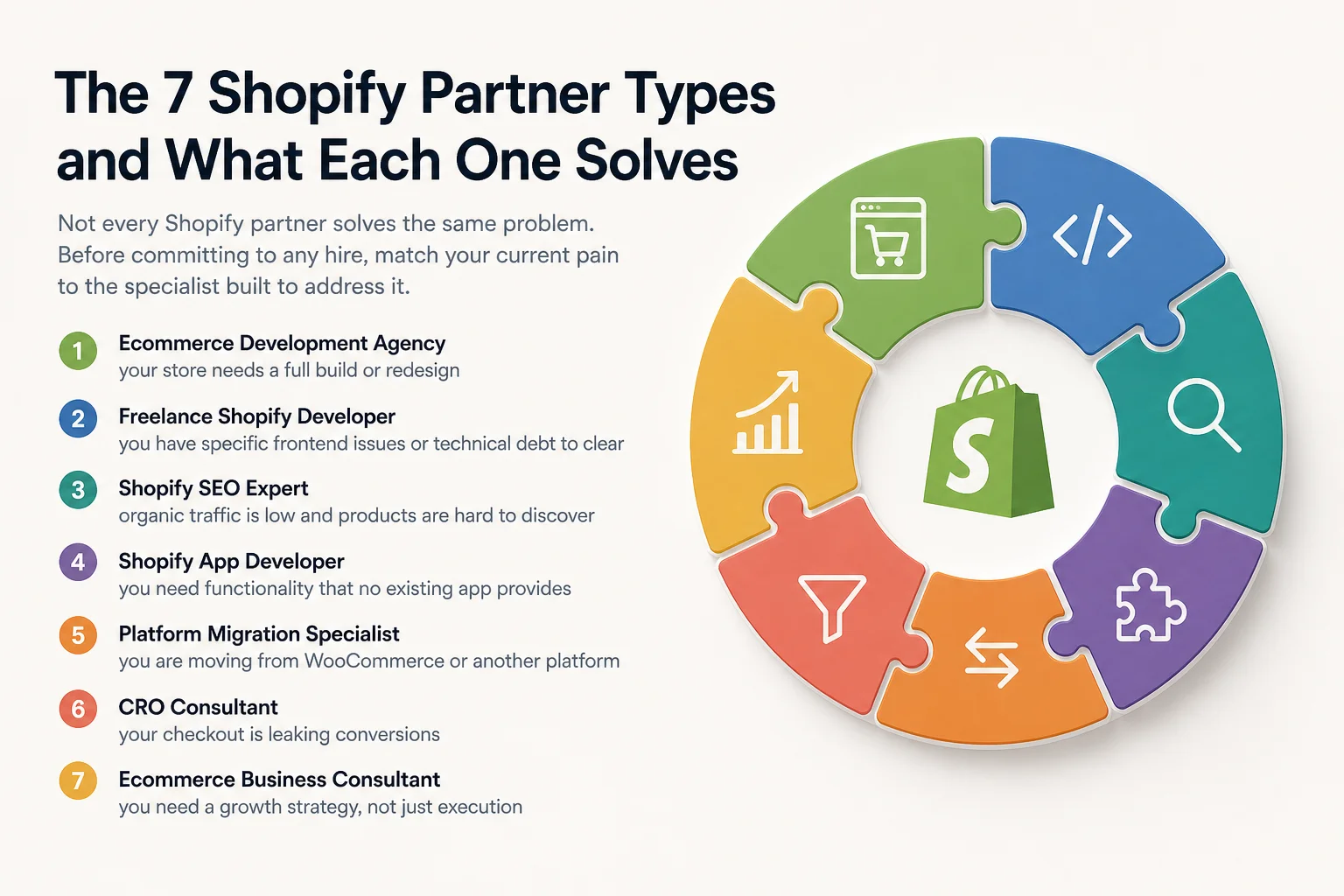
Not every Shopify partner solves the same problem. Before committing to any hire, match your current pain to the specialist built to address it.
- Ecommerce Development Agency: your store needs a full build or redesign
- Freelance Shopify Developer: you have specific frontend issues or technical debt to clear
- Shopify SEO Expert: organic traffic is low and products are hard to discover
- Shopify App Developer: you need functionality that no existing app provides
- Platform Migration Specialist: you are moving from WooCommerce or another platform
- CRO Consultant: your checkout is leaking conversions
- Ecommerce Business Consultant: you need a growth strategy, not just execution
Breaking Down Each Shopify Partner Type: When to Hire and What to Expect
1. Ecommerce Development Agency: for full storefront builds and redesigns
Your storefront no longer reflects your brand, performs poorly on mobile, or was never built for conversion in the first place. A development agency handles the full scope: storefront architecture, theme development, checkout customization, performance optimization, and post-launch support. Expect a defined project process with discovery, design, build, and handoff phases.
The wrong-fit signal: if you only need one specific fix, an agency engagement will be scoped and priced beyond what the problem requires.
Karishma Garg's ecommerce development and consulting service works in this space, combining full-stack development with storefront strategy to build performant, conversion-focused Shopify stores. If your store is underperforming and you need someone who owns both the technical build and the user journey thinking, this is what that partnership looks like in practice.
2. Freelance Shopify Developer: for targeted frontend fixes and technical debt
Your core storefront is functional, but specific components are slow, broken, or blocking improvements. A freelance Shopify developer can resolve discrete frontend issues faster and at lower cost than an agency. They work well for theme modifications, speed improvements, customer login and account flow fixes, and clearing accumulated technical debt.
The wrong-fit signal: if your store needs a strategic redesign rather than targeted fixes, a freelancer will patch symptoms without addressing the underlying structure.
3. Shopify SEO Expert: for organic traffic and product discovery
Products exist in your catalog but customers cannot find them through search. A Shopify SEO expert audits your site architecture, optimizes product and collection page metadata, improves internal linking, and addresses technical SEO issues that slow down crawling and indexing. They understand how Shopify store structures affect search performance.
The wrong-fit signal: if your traffic is healthy but not converting, SEO is not the primary lever. You need a CRO consultant instead.
4. Shopify App Developer: for custom functionality beyond native features
Shopify's native features and the best apps in the Shopify App Store cover a wide range, but some business requirements fall outside them. A Shopify app developer builds custom apps or private integrations, whether that is a bespoke product configurator, a specific integration with your ERP, or a connection between Shopify and QuickBooks that goes beyond standard syncing tools.
The wrong-fit signal: if an existing app already solves the problem at reasonable cost, custom development adds time and maintenance burden that is rarely worth it at early growth stages.
5. Platform Migration Specialist: for moving from WooCommerce or another platform
WooCommerce pricing, plugin overhead, and hosting complexity push many store owners toward Shopify, but a poor migration breaks URLs, loses product data, and tanks search rankings. A migration specialist manages the technical transfer of products, customers, and order history while preserving SEO equity. They also handle redirects and validate that your domain and redirects are configured correctly post-move.
The wrong-fit signal: if you are already on Shopify and simply need a redesign, a migration specialist is not the right hire.
6. Conversion Rate Optimization (CRO) Consultant: for fixing poor checkout and low conversion
Traffic is coming in but revenue does not reflect it. A CRO consultant analyzes your full funnel, identifies friction points in the Shopify checkout, and runs structured tests to improve conversion at each step. They look at product page layout, add-to-cart rates, cart abandonment, and checkout completion. The payment experience and how buyers move through the purchase flow are both within scope.
The wrong-fit signal: if your store has very low traffic, you do not have enough data to run meaningful tests yet.
7. Ecommerce Business Consultant: for strategy, growth planning, and scaling operations
Your store is generating revenue but growth has plateaued and you are unsure where to focus next. An ecommerce business consultant brings a strategic lens to your entire operation, from pricing and channel mix to fulfillment and customer retention. They are not executors. They help you decide what to build, fix, or stop before you spend money on it.
The wrong-fit signal: if you have a clear execution plan and just need someone to build it, a consultant adds cost without moving the project forward.
How to Choose the Right Shopify Partner for Your Store Stage
The right partner depends on what is actually slowing your store down, not on what sounds most impressive in a proposal.
Match partner type to your store's biggest bottleneck
Use this table to move from pain point to partner type quickly.
| Pain point | Recommended partner type |
|---|---|
| Store is slow or not mobile-optimized | Ecommerce Development Agency or Freelance Developer |
| Products are hard to find through search | Shopify SEO Expert |
| Checkout flow is confusing or abandoned often | CRO Consultant |
| Need functionality no app provides | Shopify App Developer |
| Moving from WooCommerce or another platform | Platform Migration Specialist |
| Revenue is flat with no clear cause | Ecommerce Business Consultant |
| Full storefront build or brand-level redesign | Ecommerce Development Agency |
Start with your single biggest constraint. Trying to hire for multiple problems at once often produces a diluted engagement that solves none of them well.
Questions to ask before signing any Shopify partner agreement
Asking the right questions before hiring separates genuine specialists from generalists who just have a Shopify login. Prepare to ask these before committing to any partner:
- Can you show specific examples of page speed improvements or conversion lifts from past projects?
- How do you handle post-launch support when issues surface after go-live?
- What is your process for understanding the business goal behind a technical request?
- Do most of your clients come through referrals, and can I speak with one?
- How do you stay current with Shopify platform updates and partner program changes?
Strong partners answer these questions with specifics, not generalities. If a candidate leads with tools and technology rather than outcomes and process, that is a signal worth taking seriously. Before you reach out, use Shopify's own hiring guidance too: define your budget, timeline, and expected outcomes in detail so any quote you get is accurate.
Frequently Asked Questions
What is the difference between a Shopify Partner and a Shopify Expert?
A Shopify Partner is anyone registered in Shopify's Partner Program, which includes developers, designers, agencies, and app creators. "Shopify Expert" was the name of the older Experts Marketplace, which Shopify replaced with the Partner Directory in October 2023. Today, the Directory is where merchants find partners, filter them by service and tier (Select, Plus, Premier, or Platinum), and read merchant reviews. Reviews are earned: a partner needs collaborator access to the store for at least a week and a Directory listing before a review can appear.
How much does it cost to hire a Shopify Partner?
Cost varies widely by partner type and scope. Freelance developers may charge hourly rates for smaller fixes, while full agency builds or redesigns are typically scoped as fixed-price projects. CRO consultants and business consultants often work on retainer. There is no single standard rate. The cleaner your brief and the more specific your requirements, the more accurate any estimate will be.
Can a Shopify Partner help with slow storefront performance?
Yes. Poor website speed is one of the most common and revenue-damaging issues on Shopify stores. Development agencies and freelance Shopify developers both work on performance, including image optimization, theme code cleanup, app load auditing, and Core Web Vitals improvements. A CRO consultant may also flag speed as a conversion issue during an audit.
Do I need a Shopify Partner if I already have an in-house developer?
It depends on the scope and specialization required. An in-house developer handles day-to-day maintenance well, but a full storefront redesign, a platform migration, or a structured CRO program often benefits from a specialist with direct experience running those specific projects. A partner can also bring outside perspective on problems an internal team has been too close to see clearly.
How do I find a trusted Shopify Partner for my ecommerce store?
The Shopify Partner Directory is a starting point. Beyond that, referrals from other ecommerce store owners carry more weight than directory listings alone. Review actual project work rather than case study summaries, and prioritize partners who ask detailed questions about your business before proposing a solution. Trust built through referrals and specific past outcomes is a more reliable signal than credentials alone.
Conclusion
Most Shopify stores do not underperform because of the platform. They underperform because the wrong type of specialist is working on the wrong problem, or because no specialist is involved at all. Now that you can see the full map, the decision is cleaner.
If you know your bottleneck, you know which partner type to hire. If you are still unsure where the friction is coming from, start with a storefront audit before committing to any build or redesign. Investing in the right diagnosis first prevents the more expensive mistake of solving the wrong problem.
If your Shopify store needs a performance-focused redesign or a storefront built for conversion from the ground up, explore Karishma Garg's ecommerce development services, built for founders and growth teams who cannot afford slow pages or broken checkout experiences.